Elysium Pool School
Elysium Pool School
We use Pool School to explain each part of our customer’s pool and how they can properly take care of it. While also teaching them a little about water chemistry and pool maintenance. We have a pdf version here, if you would like to have it for your records. Most of our pools use exclusively Jandy Equipment, so some of the instructions won’t apply to all pools but we tried to keep it as general as we could.
Pool Equipment
Filter Pumps pull water from skimmers and main drains, push water through filtration, and the return back to the pool. The hair and lint strainer needs to be cleaned weekly. We also often include a spigot on the discharge side of the pump that can be used to lower the water level of the pool. Optimal water level is ½ way up the waterline tile.
Skimmers are used to pull debris from the surface of the pool. Baskets should be emptied twice weekly or as needed.
Main Drains located in the deepest part of the pool, suck water to the pump. Debris should not be pushed into the main drain. Most of our pools have cartridge filters. These filters have 4 cartridges that need to be sprayed off with a hose. We recommend cleaning the cartridges at the end of the season, before closing. They also need to be cleaned if the pressure gauge reads 10 PSI higher than normal.
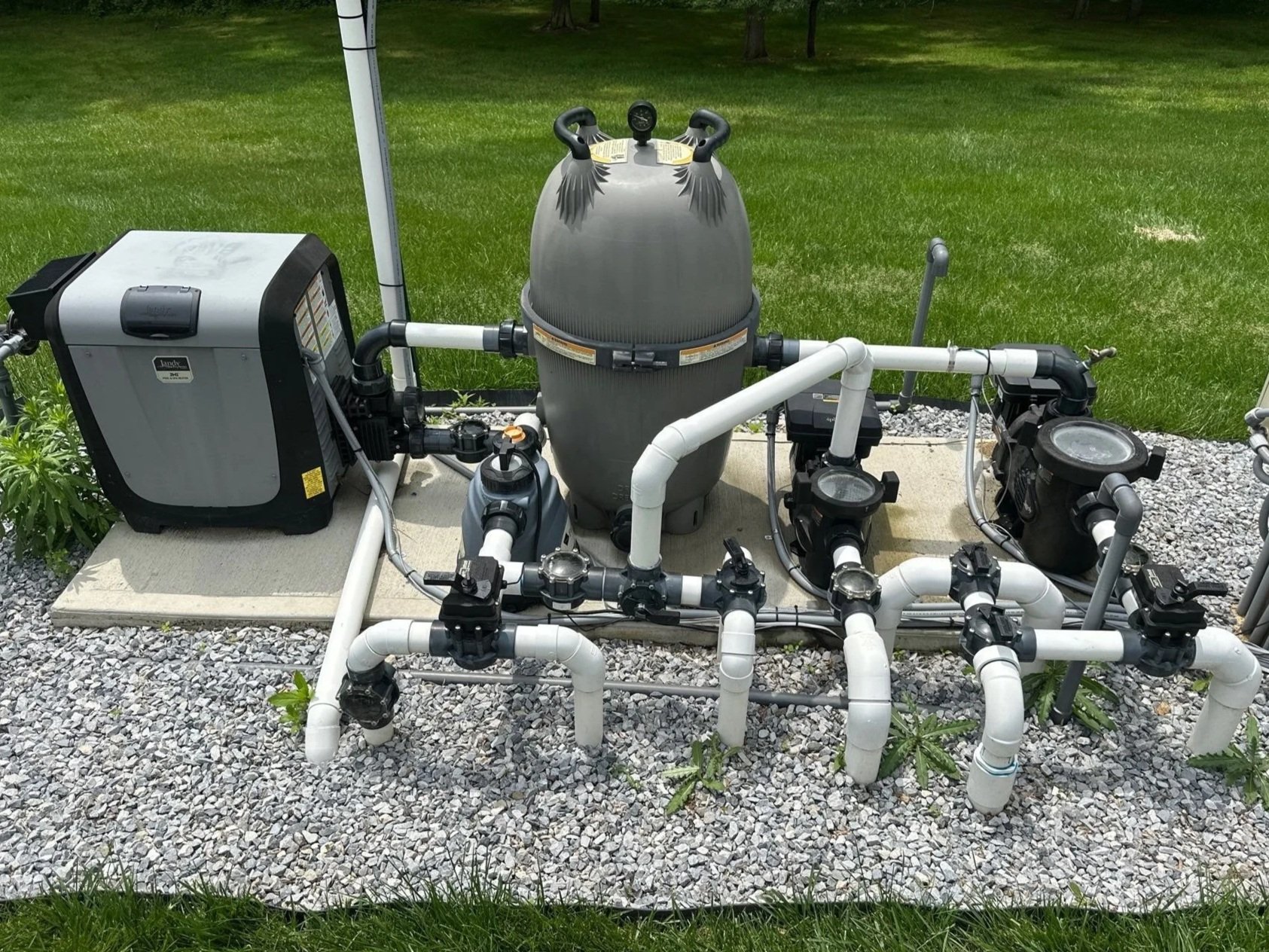
A Standard Pool/Spa Equipment Pad
Gas Heaters or Heat Pumps should not need any maintenance from the homeowner on a regular basis. Heaters should be set to 104 degrees at the heater to properly integrate with iAqualink (think, parental controls). With automation, there should be no reason to use the screen on the heater.
Salt Water Chlorine Generators (SWCG) use electrolysis to separate salt molecules into chlorine. SWCGs slowly raise the PH of the pool water. Another by product of this process can be tiny bubbles that come out of the return. SWCGs will not work when the water temperature is below 65 degrees. A common issue we see with SWCGs is calcium buildup on the cell that can cause error codes. This can be rectified by soaking the removable cell in a diluted bucket of muriatic acid, 10-water to 1-acid.
Robotic Cleaners excel at maintaining a clean pool, rather than cleaning a dirty pool. Please do not pull the cleaner out by the cord. This is the most common way robotic cleaners break and it is not covered under the warranty. We recommend running your robotic cleaner at least once a week. Most people run them more than that.
The important valves on our pools are mostly automated and will rarely need to be operated by the homeowner. As we mentioned earlier, the level of your pool equipment may be flooded (below the water level of the pool). In these circumstances, an extra step of closing a valve must be done before maintenance is performed. Failure to do so can cause your pool water to drain out through the equipment. We will make sure to notify you if your pool equipment is considered a “flooded suction” system.
Elysium Pool Tip: If your pool’s surface seems stagnant, salt generator, or water features are not operating correctly, it is most likely a flow issue. Empty Skimmer Baskets —> Empty Pump Basket —> Filter Gauge and clean filters if necessary. If none of the above solve the issue please give us a call.
Before performing any maintenance on your pool equipment, you should put your system in service mode. Service mode is enabled by pressing the far left but under, AUTO, SERVICE, TIME OUT, in the top left hand corner of the Grey panel.
Make sure to check if it’s necessary to turn any valves to keep the pool from draining through open equipment. Many pools have check valves only but certain pools, flooded suction for example, will have a valve or valves that are necessary to turn before performing any maintenance.
When returning to AUTO or turning the pump back on, valving must be returned to the original positioning, a state that allows water to pass through the system. Operating the system dry or with shut valves for an extended period of time risks damage to the equipment.
Every pool is different. Environmental factors will determine how often you have to perform equipment maintenance. Our recommendations will be for the average pool, we can‘t tell you the perfect schedule for YOUR pool.
Water Chemistry
Proper water chemistry is crucial to the upkeep of your pool finish and equipment. Maintaining proper water chemistry can extend the life of your plaster and equipment for years. We recommend testing your water once a week. This can be done through a pool maintenance company, via reagent kits or taking a sample to a pool store.
If you plan to be responsible for the water chemistry we recommend buying a reagent test kit of your own. Then once a month taking your water to a pool store to get with a spin lab to double check your reagent readings.
The pool industry is slow to adapt, and many pool stores still use “range based” water chemistry charts. These stores are useful for purchasing your chemicals and getting an accurate computer read out, but their instructions for chemistry corrections are often ill advised.
We prefer to use the Langelier Saturation Index (LSI) as a way of quantifying the balance of your pool water. Water seeks balance and will work hard to get there. Water with high LSI will deposit scale on plaster, tile, and equipment. Pools with low LSI will pull calcium out of the interior finish and corrode equipment. This is referred to in the industry as etching. It is most visibly apparent on colored interior finishes and can be felt as a rough texture and/or discoloration. The only fix for etching is resurfacing the pool. Below we will explain the readings that affect LSI.
Orenda
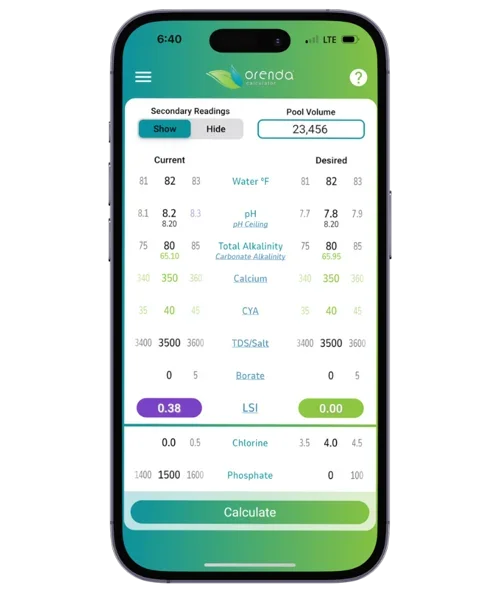
We prefer to use the Orenda Calculator to give LSI reading. There is a bit of a learning curve with the app, understanding LSI, and how to use LSI to manage your water chemistry. We have found the best practice is to get slower moving readings like calcium and salt into proper ranges, and then mostly use PH to fine tune water balance. Here is a How to guide for the Orenda App.
The Orenda app uses colors to help quantify LSI. Green is perfect and what we are striving for, while yellow is acceptable. Purple means the water is scaling, which will cause scale buildup but can be corrected. Red means the water is etching, so our goal is to never be in the red.
Most of our pools tend to drift up in PH as the week goes on. By aiming for LSI in the yellow range, we can anticipate the drift to green by the next service visit. This cycle of yellow to green is the best way to maintain the pool.
Readings and Chemicals
Water Temperature greatly affects pool balance and should always be entered when calculating LSI. Proper pool balance at 55 degrees will be drastically different than 87 degrees. You can find the temperature of your pool in the iAqualink app or by using a regular thermomotor
PH changes the fastest of all the readings and in turn has a large effect on the pool balance. PH is lowered by adding muriatic acid and raised by running water features or by adding soda ash. Precautions should always be taken when handling acid. It is irritating on the skin and extremely harmful to the eyes. Add acid to your pool, by filling a 5 gallon bucket with as much pool water as you can lift and carefully add the called for amount acid. Let stand for a few minutes, mix if possible. Then pour the bucket around the perimeter of the deep end of the pool. Do not pour on shallow areas, benches, tanning ledges, etc. You should wait two hours to swim after adding acid. You shouldn’t add more than 15 oz in a day. If for some reason you need to add more than 15 oz, you need to spread out the dosage over a day or two.
Acid that is not properly diluted, can burn your pool finish and change the color. It is important to let it fully dilute in the bucket and never pour acid directly into the pool. Again, on pools with water features, the best method for raising PH is through aeration of the water. Simply run the waterfalls/bubblers/spillover for a day and retest.
Alkalinity acts as a PH buffer. Adding muriatic acid lowers total alkalinity and adding sodium bicarbonate raises total alkalinity. Dilute in a 5 gallon bucket when adding to the pool.
Be careful sodium bicarbonate raises PH.
Calcium Hardness measures the amount of calcium in the pool. This reading is usually a point of contention with pool stores, with them recommending much lower levels. We maintain all our pools with at least 300 ppm. Dilute in a 5 gallon bucket when adding to the pool. Limit to 10 lbs per bucket. The calcium needs to be fully dissolved before being put into the pool. Undissolved calcium flakes can stick to the pool finish and cause discoloration.
Cyanuric Acid (CYA) bonds to chlorine and protects it from breaking down in the sun. However, chlorine molecules bonded with CYA aren’t as effective, therefore the chlorine needs to be higher. The chlorine should be at least 10% of the CYA, i.e., 50 CYA means 5 ppm of chlorine. We have found that our pools operate ideally at 50 CYA. The best way to add CYA to the pool is by putting it into a skimmer sock and placing it in the skimmer.
CYA should not be added to pools with auto covers.
CYA levels affect total Alkalinity. The higher CYA gets the lower Alkalinity gets.
Salinity can be found on the inside of the equipment panel and in the iAqualink App—> Web —> Status. We recommend using the readout given by the equipment rather than outside tests. The recommended salinity level is 3.0 – 3.5 gpl. Too low or too high above this range will lock out the cell from chlorine production. Note the panel displays in gpl (3.5) and web and most tests display in ppm (3,500). Low salinity can be corrected by adding pool salt directly to the pool. Pour the bag around the perimeter. Brush until all salt is dissolved. Salt can stick to plaster and change the color if not dissolved correctly.
Chlorine sanitizes the pool. We like to see 1.0 – 3.0 ppm on residential pools. Chlorine does not affect LSI but manifests in other areas. Pools with too little chlorine may become cloudy, have rapidly clogging filters, and at worst turn green with algae. High levels of chlorine can cause the water to smell and bleach clothes. The SWCG can be set to quick boost for 24hrs to provide maximum chlorine output and “shock” the pool. This can be used after a party or bad storm. Additionally, it is good practice to keep granular chlorine (Shock) on hand in case of emergencies. Again, this can stick to the plaster or worse burn the plaster, causing damage. So granular chlorine should be dissolved in a 5 gallon bucket before adding it to the pool.
Phosphates are food for algae and not usually something to worry about in a properly maintained pool. Dealt with on a case by case basis. In the Orenda example below, you can see how we can shift the LSI yellow during a service visit by adjusting PH. When possible, it is best to split up larger doses of acid to avoid over shoots. In this example, acid should be added as 8oz in the morning and 8oz at least 4 hours later.
IMPORTANT: ALWAYS ADD ACID TO WATER, NEVER WATER TO ACID
IMPORTANT: THE ONLY CORRECTION FOR HIGH CALCIUM IS DRAINING POOL WATER.
IMPORTANT: NEVER MIX ANY POOL CHEMICALS TOGETHER
AIM LOW! YOU CAN ALWAYS ADD MORE.